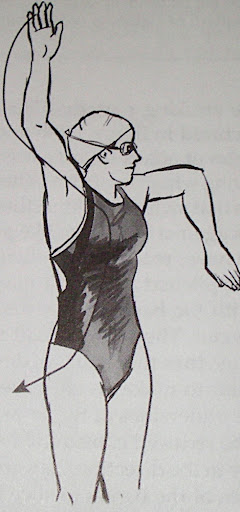
I am assuming S is still the dominant pull pattern, but if you are using I, are you using it 100% of the time and for all distances?
I am not collecting this information for any purpose, just curious how the I pattern adoption is going along and what people think of it.
S Pattern: Entering close to the median line of the body, then sculling out before beginning the catch. At the catch the hand begins an inward sweep before turning outward somewhere mid torso with the hand underneath the body. The stroke finishes and exits the water on the final outward sweep. See picture.
I Pattern: The hand enters wide of the mid line of the body with no scull before the catch. From the catch to the finish is approximately a straight line.
The difference between S and I is S has phases in different directions while I tries to maintain a single direction the entire time.
lh5.ggpht.com/.../SANY0001.JPG
Former Member
The muscular argument for the S stroke:
Imagine that you need to pull yourself up by grabbing a bar or surface above your head. You don't put your hands together. Instead, you space them at about your shoulders, b/c that's where it's easiest to exert force.
Now imagine that you're trying to lift your feet off the ground by pressing against a surface at about mid-body height, such as a kitchen counter. You put your hands closer together, in front of you, because that's where it's easiest to exert force.
So the S pattern has the advantage of moving your hands into the positions where you can exert the most amount of force in your stroke with the least amount of energy.
You can (and should) roll your hips to engage the same stronger muscle groups while using an I pull.
I was taught the S pull in the 70s and recently reformed myself based on a stroke analysis performed by Genadijus Sokolovas in May of 2009. The underwater video he took was invaluable, since I could view and compare to accomplished swimmers. I believe (although I have not had another video taken) I have reduced the S to a 'drunken I,' and increased hip roll as well. The combination certainly feels more efficient, similar to XC skiing.
I have heard that a significant stroke change like this will slow you down initially, until your musculature re-coordinates. This may be true, but my practice times (more endurance oriented) have improved. Hopefully everything will hash out by May, but I will not go back to my old S pull.
Well, what I'm doing is probably more akin to your "drunken I" than an exaggerated S. But it's definitely got the curve to it.
I think the timing of your roll will probably have a significant effect on just how "wiggly" your pull pattern is.
Do you have a gradual transition across the length of your stroke, or do you tend to skate-and-flip, skate-and-flip?
I think the I patter is more of an upside down J pattern. Pulling straight back is counterproductive to efficient propulsion but even if you tried it would be difficult so I think the upside down J is better than the S which is usually overexaggerated anyway.
I just wanted to say how interresting this discussion was. I'm getting back into swimming after being a D1 collegiate swimmer YEARS ago. I ended up quitting swimming because of an extremely efficient freestyle pull. Found out I was actually partially dislocating my left shoulder during the pull. So I'm interrested to see if my pull goes more toward the I stroke now after surgery.
I don't think I'll ever change to the I stroke fully, the S stroke works so well, but things work differently now with how I've always done things.
The small amount of research I've done, I have come to the pre-conclusion that the I pull is best for those whith little to no sulling in their pulls. Many of the drills I did for years focused specifically on diffent sculling, and it would take a very long time for me to get rid of the S pull. Like I said, I haven't done enough research on the different techniques though.
Genadijus Sokolovas (in Colorado Springs) and I (in Southern California) can scientifically and objectively test your velocity, force and acceleration on all five strokes. That is, at every point in your stroke whether it is butterfly, backstroke, breaststroke, freestyle or the Fifth Stroke, you can objectively see how fast (or slow) you are moving forward. Videos and descriptions are shown at www.swimetrics.com or www.swimbythesea.com. We also travel across the United States to conduct tests that takes the guesswork out of understanding what pull pattern or kick style is optimal for you.
Genadijus Sokolovas (in Colorado Springs) and I (in Southern California) can scientifically and objectively test your velocity, force and acceleration on all five strokes. That is, at every point in your stroke whether it is butterfly, backstroke, breaststroke, freestyle or the Fifth Stroke, you can objectively see how fast (or slow) you are moving forward. Videos and descriptions are shown at www.swimetrics.com or www.swimbythesea.com. We also travel across the United States to conduct tests that takes the guesswork out of understanding what pull pattern or kick style is optimal for you.
Do you have any insights into which pull pattern seems to work best for most people, or for different types of people?
Genadijus Sokolovas (in Colorado Springs) and I (in Southern California) can scientifically and objectively test your velocity, force and acceleration on all five strokes. That is, at every point in your stroke whether it is butterfly, backstroke, breaststroke, freestyle or the Fifth Stroke, you can objectively see how fast (or slow) you are moving forward. Videos and descriptions are shown at www.swimetrics.com or www.swimbythesea.com. We also travel across the United States to conduct tests that takes the guesswork out of understanding what pull pattern or kick style is optimal for you.
I think you can objectively see how fast you're moving forward with a friend and a stopwatch.
I think you can objectively see how fast you're moving forward with a friend and a stopwatch.
you are kidding right? i think it's pretty cool and would like to try it.
If I don't skull, my hand may vibrate from turbulence and it feels wasteful since the object is to grab the water to carry your body forward, and turbulence means your just moving the hand through the water.
Dolphin kick free is a drill that seems to help for me by placing importance on effective hand movement.