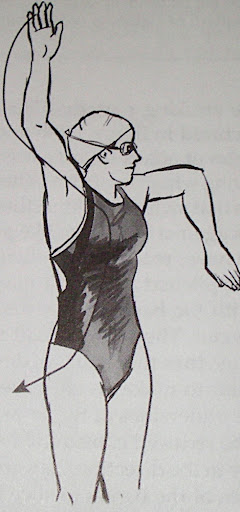
I am assuming S is still the dominant pull pattern, but if you are using I, are you using it 100% of the time and for all distances?
I am not collecting this information for any purpose, just curious how the I pattern adoption is going along and what people think of it.
S Pattern: Entering close to the median line of the body, then sculling out before beginning the catch. At the catch the hand begins an inward sweep before turning outward somewhere mid torso with the hand underneath the body. The stroke finishes and exits the water on the final outward sweep. See picture.
I Pattern: The hand enters wide of the mid line of the body with no scull before the catch. From the catch to the finish is approximately a straight line.
The difference between S and I is S has phases in different directions while I tries to maintain a single direction the entire time.
lh5.ggpht.com/.../SANY0001.JPG
I have been using the "S" pattern for as long as I can remember. It feels as natural as chewing gum... However over the past 6 months I have been encouraged by my coaches to bring my elbow up higher, using my larger back muscles (and forearm) versus the shoulder, pulling in a straight back "I" pattern. By doing so I am confident it has has resulted in less stress on my shoulder-a very good thing considering my shoulder was showing signs of lasting fatigue/tendinitis following intense LCM summer workouts. However changing from S to I has also forced me to focus on my catch. With the S, it was natural to catch and sweep out slightly. With the I it is easier to "slip" if I do not engage right at the start of the stroke and if I forget to keep my elbow at the right angle. But it is almost second nature after a few months of technique drills.
I am very happy with the results so far. I believe using the stronger back (LAT) muscles compared to the smaller shoulder muscles has given me added power in my sprint events. I also have not had shoulder stress (but that could be a number of things...). I have started seeing the results in races as well - with a recent SCM 50 Free (TYR Chicago) very close to my lifetime best (24 years ago...). :2cents:
Very descriptive drawing of what I assume is the "S" stroke-
lh5.ggpht.com/.../SANY0001.JPG
A comparable one of the "I" stroke would really help!
Since I converted to EVF with my elbows near the surface, I experienced my upperbody wanting to oscilate, or zig-zag down the lane. (I wear size 38 dress shirt sleeve, so my upper arms are like long outriggers!) I have been finding I can compensate for this with an "S" stroke of my hand.
Could the "S" stroke tied to EVF?
Thanks,
Georgio
It isn't more efficient.The "S" was developed when the idea was that the pull was predominantly lift dominated(like sculling.)Since the current thought is that the pull is drag dominant,it is much straighter.
From what I understand, the S wasn't developed, but discovered, when observation of elite swimmers revealed that they didn't use an idealized straight stroke, but rather moved from side to side as they pulled, and it was that discovery which sparked interest in the whole drag/lift thing, which ended up going pretty much nowhere.
I was taught the S pattern because it worked. Which it definitely did.
Once I developed a better water-feel, I settled into my own stroke pattern, based on where I was feeling the greatest purchase against the water. And for me, a variation of the S pattern gives me that.
ETA: With a straight stroke, you generate a greater leading break, which makes your hand move through the water more easily, which is not what you want. Varying the angle and transverse location of your hand allows you to constantly move out of that leading pocket, which gives you a more resistent column of water to push against through the entire range of your stroke.
Yes, the large back muscles engaged with EVF offer a lot of power.
For the "I" stroke, combined with EVF, would your hand entry be out in front of your shoulder and pull back in a straight line to exit just past and near hip?
Thanks,
Georgio
I'm sure I don't truly do an 'I' pull, but I don't consciously try to scull either. When I pull I'm thinking about moving the hand straight back. As Tom said it's probably more of a J since your hand does need to clear your hip as it exits the water.
Is "scull" the correct word?
When I think of sculling, I think of slicing sideways through the water. With an angled blade, yes, but still, more of a slice than a push.
When I pull in an S pattern, the point is always to propel forward by pushing backward; there's never an attempt to use any sort of propeller-like force or anything like that.
A true S can have some sculling(lift dominant force) due to the fact that the hand moves somewhat perpendicular to the direction of propulsion.It is my understanding that the "I" has little or no sculling.
Is "scull" the correct word?
When I think of sculling, I think of slicing sideways through the water. With an angled blade, yes, but still, more of a slice than a push.
When I pull in an S pattern, the point is always to propel forward by pushing backward; there's never an attempt to use any sort of propeller-like force or anything like that.
The muscular argument for the S stroke:
Imagine that you need to pull yourself up by grabbing a bar or surface above your head. You don't put your hands together. Instead, you space them at about your shoulders, b/c that's where it's easiest to exert force.
Now imagine that you're trying to lift your feet off the ground by pressing against a surface at about mid-body height, such as a kitchen counter. You put your hands closer together, in front of you, because that's where it's easiest to exert force.
So the S pattern has the advantage of moving your hands into the positions where you can exert the most amount of force in your stroke with the least amount of energy.
You can (and should) roll your hips to engage the same stronger muscle groups while using an I pull.
I was taught the S pull in the 70s and recently reformed myself based on a stroke analysis performed by Genadijus Sokolovas in May of 2009. The underwater video he took was invaluable, since I could view and compare to accomplished swimmers. I believe (although I have not had another video taken) I have reduced the S to a 'drunken I,' and increased hip roll as well. The combination certainly feels more efficient, similar to XC skiing.
I have heard that a significant stroke change like this will slow you down initially, until your musculature re-coordinates. This may be true, but my practice times (more endurance oriented) have improved. Hopefully everything will hash out by May, but I will not go back to my old S pull.