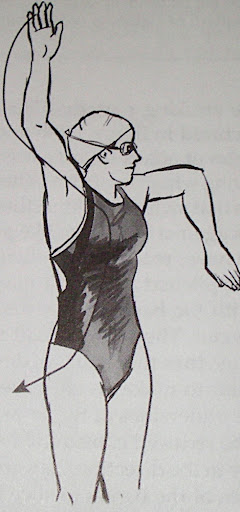
I am assuming S is still the dominant pull pattern, but if you are using I, are you using it 100% of the time and for all distances?
I am not collecting this information for any purpose, just curious how the I pattern adoption is going along and what people think of it.
S Pattern: Entering close to the median line of the body, then sculling out before beginning the catch. At the catch the hand begins an inward sweep before turning outward somewhere mid torso with the hand underneath the body. The stroke finishes and exits the water on the final outward sweep. See picture.
I Pattern: The hand enters wide of the mid line of the body with no scull before the catch. From the catch to the finish is approximately a straight line.
The difference between S and I is S has phases in different directions while I tries to maintain a single direction the entire time.
lh5.ggpht.com/.../SANY0001.JPG
Parents
Former Member
Genadijus Sokolovas (in Colorado Springs) and I (in Southern California) can scientifically and objectively test your velocity, force and acceleration on all five strokes. That is, at every point in your stroke whether it is butterfly, backstroke, breaststroke, freestyle or the Fifth Stroke, you can objectively see how fast (or slow) you are moving forward. Videos and descriptions are shown at www.swimetrics.com or www.swimbythesea.com. We also travel across the United States to conduct tests that takes the guesswork out of understanding what pull pattern or kick style is optimal for you.
I think you can objectively see how fast you're moving forward with a friend and a stopwatch.
Genadijus Sokolovas (in Colorado Springs) and I (in Southern California) can scientifically and objectively test your velocity, force and acceleration on all five strokes. That is, at every point in your stroke whether it is butterfly, backstroke, breaststroke, freestyle or the Fifth Stroke, you can objectively see how fast (or slow) you are moving forward. Videos and descriptions are shown at www.swimetrics.com or www.swimbythesea.com. We also travel across the United States to conduct tests that takes the guesswork out of understanding what pull pattern or kick style is optimal for you.
I think you can objectively see how fast you're moving forward with a friend and a stopwatch.