I am assuming S is still the dominant pull pattern, but if you are using I, are you using it 100% of the time and for all distances?
I am not collecting this information for any purpose, just curious how the I pattern adoption is going along and what people think of it.
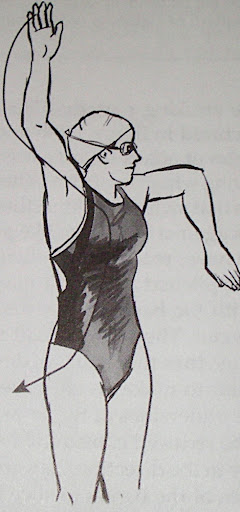
S Pattern: Entering close to the median line of the body, then sculling out before beginning the catch. At the catch the hand begins an inward sweep before turning outward somewhere mid torso with the hand underneath the body. The stroke finishes and exits the water on the final outward sweep. See picture.
I Pattern: The hand enters wide of the mid line of the body with no scull before the catch. From the catch to the finish is approximately a straight line.
The difference between S and I is S has phases in different directions while I tries to maintain a single direction the entire time.
lh5.ggpht.com/.../SANY0001.JPG
The muscular argument for the S stroke:
Imagine that you need to pull yourself up by grabbing a bar or surface above your head. You don't put your hands together. Instead, you space them at about your shoulders, b/c that's where it's easiest to exert force.
Now imagine that you're trying to lift your feet off the ground by pressing against a surface at about mid-body height, such as a kitchen counter. You put your hands closer together, in front of you, because that's where it's easiest to exert force.
So the S pattern has the advantage of moving your hands into the positions where you can exert the most amount of force in your stroke with the least amount of energy.
You can (and should) roll your hips to engage the same stronger muscle groups while using an I pull.
I was taught the S pull in the 70s and recently reformed myself based on a stroke analysis performed by Genadijus Sokolovas in May of 2009. The underwater video he took was invaluable, since I could view and compare to accomplished swimmers. I believe (although I have not had another video taken) I have reduced the S to a 'drunken I,' and increased hip roll as well. The combination certainly feels more efficient, similar to XC skiing.
I have heard that a significant stroke change like this will slow you down initially, until your musculature re-coordinates. This may be true, but my practice times (more endurance oriented) have improved. Hopefully everything will hash out by May, but I will not go back to my old S pull.
The muscular argument for the S stroke:
Imagine that you need to pull yourself up by grabbing a bar or surface above your head. You don't put your hands together. Instead, you space them at about your shoulders, b/c that's where it's easiest to exert force.
Now imagine that you're trying to lift your feet off the ground by pressing against a surface at about mid-body height, such as a kitchen counter. You put your hands closer together, in front of you, because that's where it's easiest to exert force.
So the S pattern has the advantage of moving your hands into the positions where you can exert the most amount of force in your stroke with the least amount of energy.
You can (and should) roll your hips to engage the same stronger muscle groups while using an I pull.
I was taught the S pull in the 70s and recently reformed myself based on a stroke analysis performed by Genadijus Sokolovas in May of 2009. The underwater video he took was invaluable, since I could view and compare to accomplished swimmers. I believe (although I have not had another video taken) I have reduced the S to a 'drunken I,' and increased hip roll as well. The combination certainly feels more efficient, similar to XC skiing.
I have heard that a significant stroke change like this will slow you down initially, until your musculature re-coordinates. This may be true, but my practice times (more endurance oriented) have improved. Hopefully everything will hash out by May, but I will not go back to my old S pull.