I am assuming S is still the dominant pull pattern, but if you are using I, are you using it 100% of the time and for all distances?
I am not collecting this information for any purpose, just curious how the I pattern adoption is going along and what people think of it.
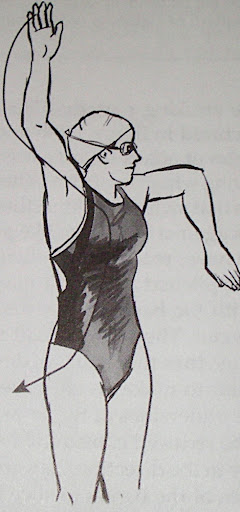
S Pattern: Entering close to the median line of the body, then sculling out before beginning the catch. At the catch the hand begins an inward sweep before turning outward somewhere mid torso with the hand underneath the body. The stroke finishes and exits the water on the final outward sweep. See picture.
I Pattern: The hand enters wide of the mid line of the body with no scull before the catch. From the catch to the finish is approximately a straight line.
The difference between S and I is S has phases in different directions while I tries to maintain a single direction the entire time.
lh5.ggpht.com/.../SANY0001.JPG
From what I understand, the S wasn't developed, but discovered, when observation of elite swimmers revealed that they didn't use an idealized straight stroke, but rather moved from side to side as they pulled, and it was that discovery which sparked interest in the whole drag/lift thing, which ended up going pretty much nowhere.
I was taught the S pattern because it worked. Which it definitely did.
Once I developed a better water-feel, I settled into my own stroke pattern, based on where I was feeling the greatest purchase against the water. And for me, a variation of the S pattern gives me that.
ETA: With a straight stroke, you generate a greater leading break, which makes your hand move through the water more easily, which is not what you want. Varying the angle and transverse location of your hand allows you to constantly move out of that leading pocket, which gives you a more resistent column of water to push against through the entire range of your stroke.
Right,in that it was Councilman's observations that showed the nascent S,but it was his theorizing that led to it's wide acceptance.He really had 2 theories about the S,the lift theory and the"search for calm water" theory.
As I said,no one pushes straight back which does mean that we are pretty much getting calm water the whole time,plus accelerating the hands also mitigates this problem.Led by the Australians(who I believe never were as enamored of the S) the faster freestylers evolved to a more straight back pull.There are certainly still some very fast S swimmers.
From what I understand, the S wasn't developed, but discovered, when observation of elite swimmers revealed that they didn't use an idealized straight stroke, but rather moved from side to side as they pulled, and it was that discovery which sparked interest in the whole drag/lift thing, which ended up going pretty much nowhere.
I was taught the S pattern because it worked. Which it definitely did.
Once I developed a better water-feel, I settled into my own stroke pattern, based on where I was feeling the greatest purchase against the water. And for me, a variation of the S pattern gives me that.
ETA: With a straight stroke, you generate a greater leading break, which makes your hand move through the water more easily, which is not what you want. Varying the angle and transverse location of your hand allows you to constantly move out of that leading pocket, which gives you a more resistent column of water to push against through the entire range of your stroke.
Right,in that it was Councilman's observations that showed the nascent S,but it was his theorizing that led to it's wide acceptance.He really had 2 theories about the S,the lift theory and the"search for calm water" theory.
As I said,no one pushes straight back which does mean that we are pretty much getting calm water the whole time,plus accelerating the hands also mitigates this problem.Led by the Australians(who I believe never were as enamored of the S) the faster freestylers evolved to a more straight back pull.There are certainly still some very fast S swimmers.