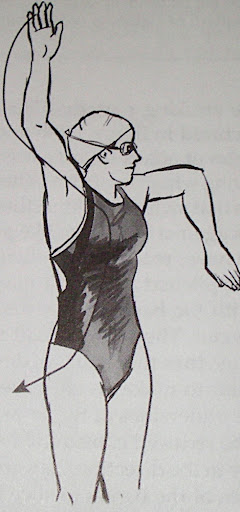
I am assuming S is still the dominant pull pattern, but if you are using I, are you using it 100% of the time and for all distances?
I am not collecting this information for any purpose, just curious how the I pattern adoption is going along and what people think of it.
S Pattern: Entering close to the median line of the body, then sculling out before beginning the catch. At the catch the hand begins an inward sweep before turning outward somewhere mid torso with the hand underneath the body. The stroke finishes and exits the water on the final outward sweep. See picture.
I Pattern: The hand enters wide of the mid line of the body with no scull before the catch. From the catch to the finish is approximately a straight line.
The difference between S and I is S has phases in different directions while I tries to maintain a single direction the entire time.
lh5.ggpht.com/.../SANY0001.JPG
Parents
Former Member
Free style: S pattern (most definitely. see note below)
Back Stroke: I hate this stroke.
*** Stroke: Relatively wide pulling
Butterfly: I enter at shoulders width, don't go much passed this, then my hand are almost touching themselves underneath my body before final push
Note on my S pattern. I absolutely don't perform any outward scull upon entry though. I find it is in contradiction with the body motion. So for me it's entry then flex the wrist then along with the body rotation, hand is going inward then outward, again following body rotation.
So down, in, then out and up. Not entirely an S I guess, but not an I neither.
Free style: S pattern (most definitely. see note below)
Back Stroke: I hate this stroke.
*** Stroke: Relatively wide pulling
Butterfly: I enter at shoulders width, don't go much passed this, then my hand are almost touching themselves underneath my body before final push
Note on my S pattern. I absolutely don't perform any outward scull upon entry though. I find it is in contradiction with the body motion. So for me it's entry then flex the wrist then along with the body rotation, hand is going inward then outward, again following body rotation.
So down, in, then out and up. Not entirely an S I guess, but not an I neither.